
A Series of Tubes
“Your mind is for having ideas, not holding them.” — David Allen, Getting Things Done
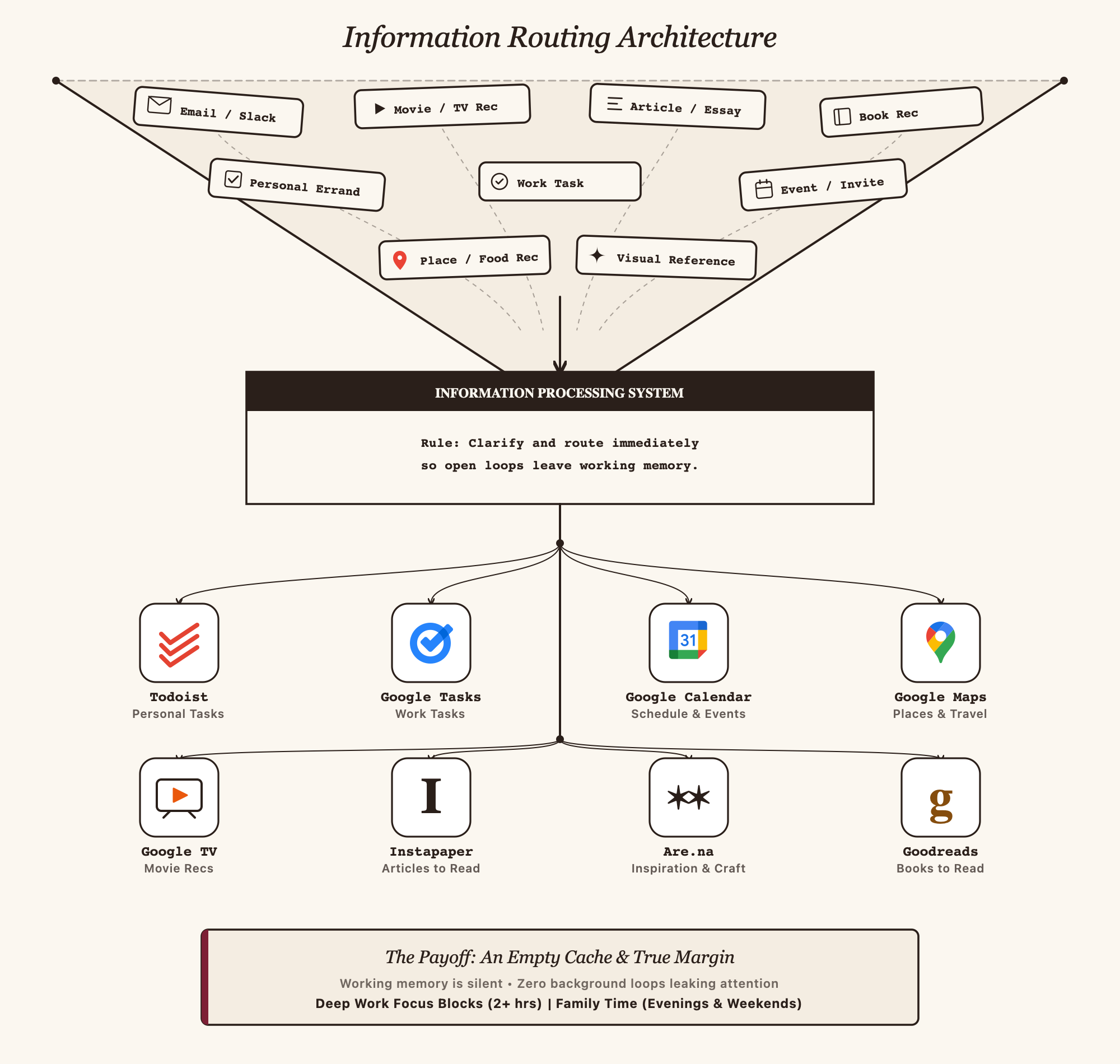
Like a lot of people who spend more time online than they’d like, I have a near-constant stream of requests, questions, ideas, and FYIs coming at me in the form of instant messages, text messages, RSS feeds, meetings, email newsletters, conversations with friends, emails from my kids’ school, social media, phone notifications, and on and on.
Here’s a random sample of recent examples:
- Ask the contractor about a broken outlet cover
- Look into courses to improve my public speaking skills
- Email $Colleague about $Topic
- Read Jon Ronson’s new book The Castle
- Remember: no school on $date due to teacher development
- Buy AAA batteries
- Finally get around to watching Obsession
How to manage it all? These all vary in terms of importance, context needed, materials needed, timeliness, etc., so having them in a flat list isn’t super helpful.
The best thing I can do is limit unwanted inputs upstream by disabling notifications, setting digital boundaries like “Do Not Disturb” mode, unsubscribing from email newsletters, or deactivating my social media profiles. I’ve already done a pretty good job of filtering what comes at me in the first place.
Still, the question remains: how do I remain curious and open to the world, accountable to others and the obligations I’ve made, and also retain some semblance of mental wellbeing and room for serendipity?
I used to think it was a discipline or willpower issue — “if I can just get more done today, that’ll free up time for what matters.” But the stream of to-dos never stops, and action items in my head become “open loops” that either slip away or, worse, act as a constant ~10% drag on my attention, nagging me NOT to forget.
The tactic that keeps me sane is treating incoming channels like tubes instead of buckets.
“Email is really nothing more than a medium. [Senator Stevens] might say it’s a tube. It gets things from one place to another... There’s no need for you to live in email... I really believe there’s a single place for anything.” — Merlin Mann
Here’s how I do it:
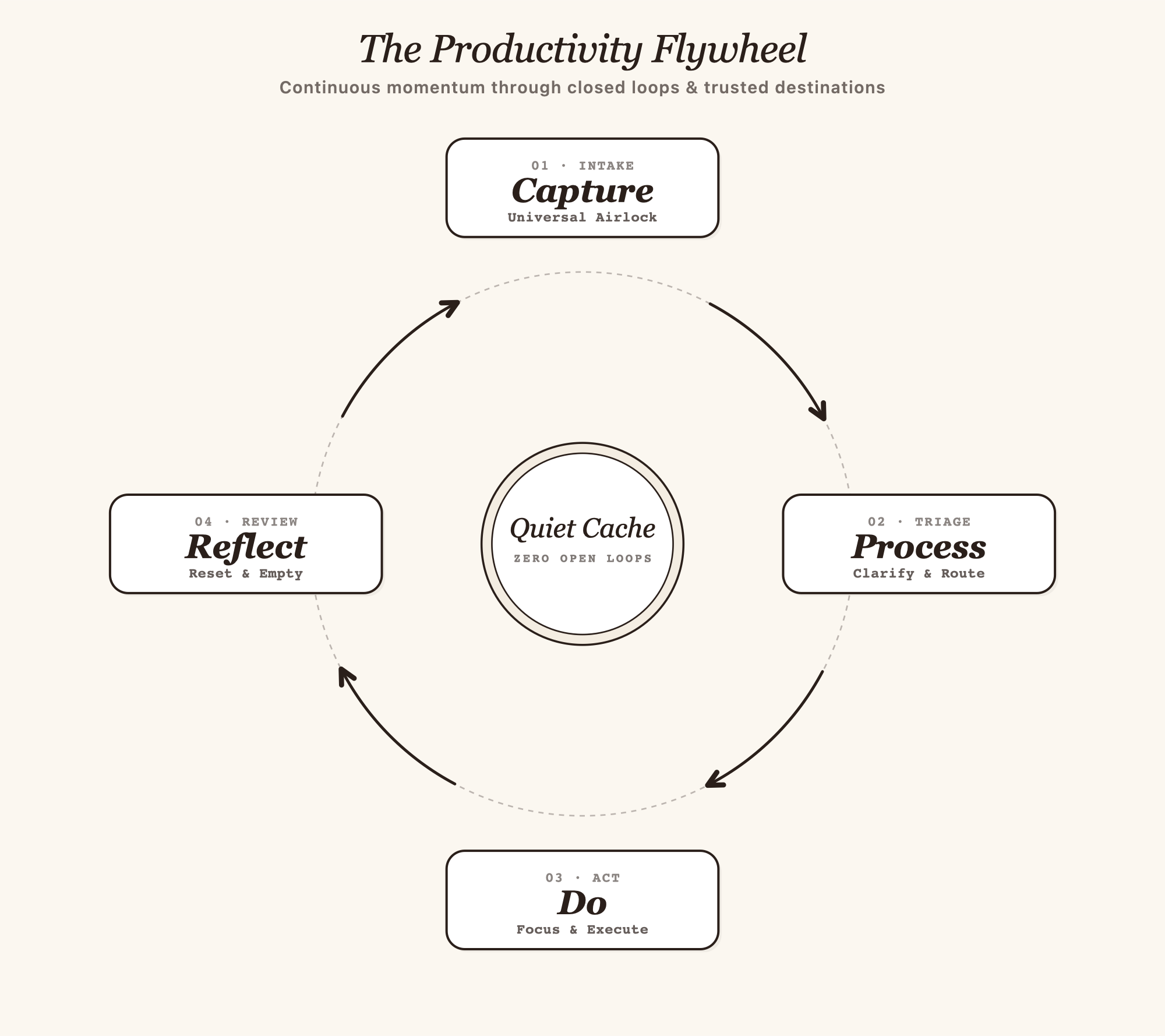
1. Capture
- The goal of this step is to have an “Inbox” of some kind.
- I make this as frictionless as possible to minimize the time between when I have an idea, and when the idea is “on paper” somewhere I’m sure to check.
- iOS Shortcuts, the iPhone’s Action Button, keyboard shortcuts, and physical notebooks have all been helpful for me here.
- Think of a birthday gift for your spouse while in line at the coffee shop? Chuck it in the Inbox and move on with your day.
2. Process
- As Merlin puts it: “Once you know where stuff goes, it gets a lot easier to figure out where to put it. And having an idea in your head about where stuff needs to land and where it could potentially live forever, that’s your job to figure out.”
- Once or twice a day, I review everything in the Inbox and route it to its permanent home: save the book to my Goodreads “Want to Read” list, add the ingredient to our shared family grocery list, create a proper To-Do in my work task tool, or save the gift idea for my wife in a dedicated Private Are.na channel.
- Thinking about where this stuff should go also forces me to do a few things: 1. If it’s an easy task that I can do in < 2 minutes, I’ll often just do it and skip the task relocation altogether. 2. If it’s the beginning of a larger project of some kind, I’ll try to distill the item into 1 tangible next step. The thought to “Get better at public speaking” becomes a task called “Spend 10 minutes researching internal resources for improving public speaking”.
- (Note: Capture & Process are often combined if it’s just as easy for me to process an item immediately as it is to capture it. For example, it takes 1 click for me to save an article to Instapaper via a Chrome Extension.)
3. Do
- This is what it’s all about, and where life happens, dictated by my calendar, context, mood, and interests.
- Do I have 10 minutes in the doctor’s office waiting room? My YouTube Watch Later already has a dozen videos that I want to watch.
- Do I have 25 minutes in between meetings? I pull up my list of work to-dos and knock a few things out.
- There’s very little cognitive overhead or reason to procrastinate, as a lot of the choices have been made by a previous version of myself.
- I don’t want to be thinking about work to-dos when my wife and I are settling in to watch something on Netflix. If those to-dos are in the right place, I don’t have to.
4. Reflect
- Everything up to this point can be as simple or complicated as you want, using digital or analog tools, but IMO, here is where the power & potential of AI is most obvious.
- Assuming you’ve been capturing, processing, and doing things for a while, you’ve probably built up quite a collection of stuff.
- On its face, a long list of completed tasks isn’t all that helpful, but AI can make sense of this “digital exhaust” that has piled up:
- “Here are the 20 books I’ve read and rated in the last 2 years. What additional authors might I be interested in?”
- “Here’s a list of tasks I’ve completed at work over the last 6 months. How am I progressing against my team’s annual goals?”
- “Here are some interior design images I’ve saved for inspiration — what do they have in common, and how might I articulate this style to an interior designer?”
None of this carries any moral valence — I’m not here to tell you to “just be more productive, bro,” or to squeeze an extra 4% of output from your day to be a better cog in the capitalist machine. The system is supposed to serve you, not the other way around, and whether you want to be the foremost expert on the latest Netflix reality series or earn a PhD, what you put through the tubes is up to you.
What I do believe is that if you say certain things are important to you, you owe it to yourself to actually try to do them, rather than letting the whims of your inbox or a social media algorithm decide how you spend your life. For me, when every commitment, book recommendation, and errand has an unambiguous home, the background noise finally shuts off, and my actions actually reflect the things I say are important to me.
Member discussion